Oct
20
7:00 PM19:00

Learning from Cemeteries: Preservation Training in Burial Spaces

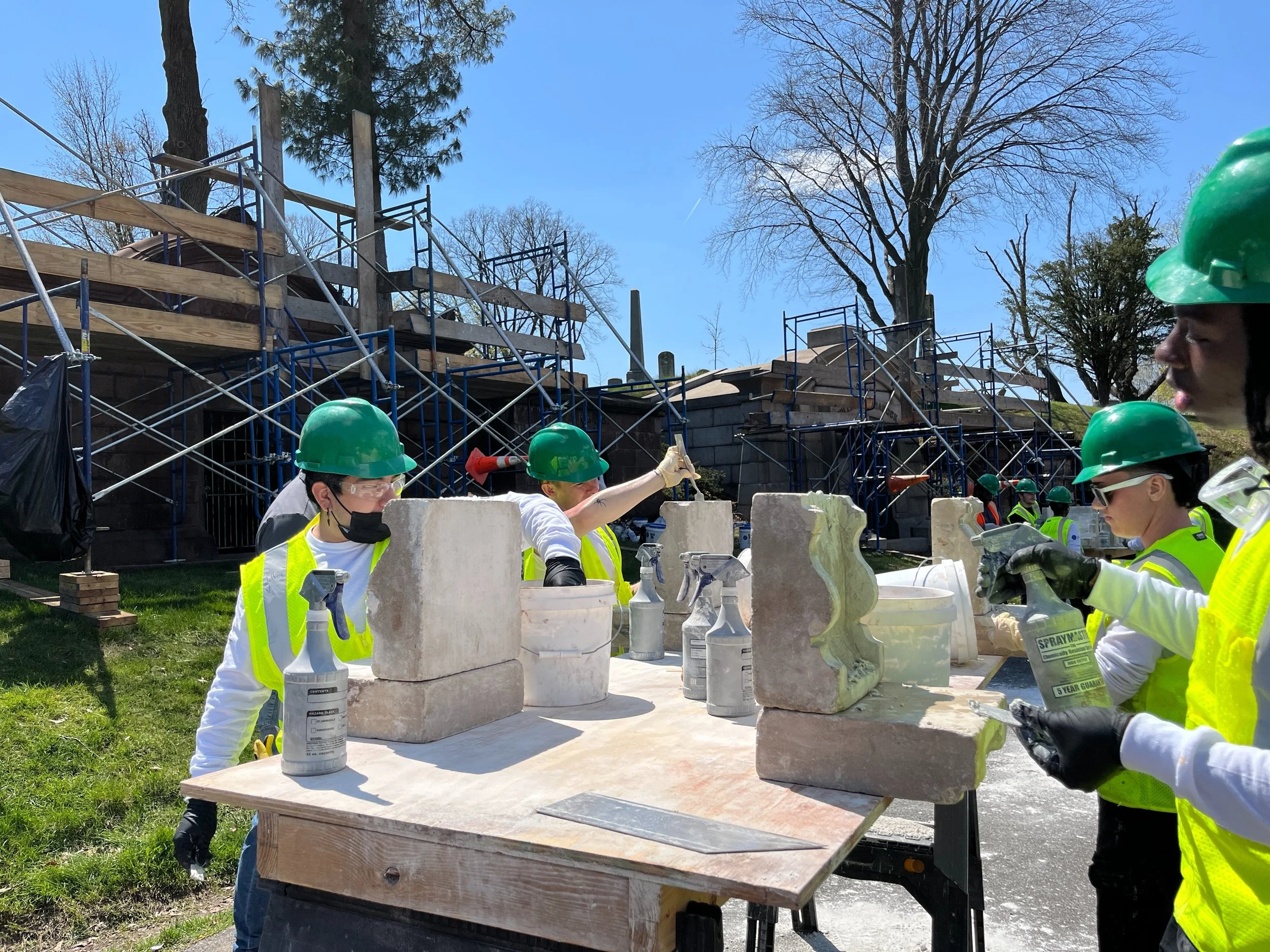
Historic cemeteries provide a unique landscape for the living to learn from those that came before them. Interaction with a memorial, whether a monumental stone obelisk or a humble marker, is a shared human experience where individuals encounter and make sense of the past. Often, these experiences can serve as a gateway into the field of historic preservation.

In recent years, a number of trades training initiatives (notably, the Bridge to Craft Careers Program at World Monument Fund) have offered the opportunity for interested students to explore and learn skills in historic masonry, metalwork and plasterwork in historic cemetery landscapes. This unique partnership offers exposure to immense architectural resources for students, and provides much needed support in the care and conservation of significant cultural heritage. HPEF has invited the following innovators to discuss and share their work:

  • Elimarie Garcia-Cosme is the Global Heritage Training Manager at World Monuments Fund (WMF). In this role, she collaborates with WMF's global team to guide the development and implementation of heritage training initiatives. Since joining WMF in 2020, she has supported international field projects and training programs across diverse cultural contexts, including initiatives focused on community engagement, climate resilience, and inclusive heritage. Elimarie holds a B.A. in Anthropology from the University of Texas at San Antonio, an M.A. in Anthropology from the University of Central Florida, and an M.A. in Cultural Heritage Studies from University College London.

  • Karina Roca is the Bridge to Crafts Careers Program Manager for the Preservation Resource Center of New Orleans. She is a 5-year blacksmith apprentice and an advocate for the preservation of traditional building trades in New Orleans.  As the Bridge to Crafts Career Program Manager, she is actively cultivating a pathway for participants to gain hands-on skills in the traditional trades essential to the stewardship and preservation of historic buildings.  With experience in workforce development and the stewardship of intangible cultural heritage, she also seeks to build bridges between vocational skills and academic research.  Karina Roca holds a Bachelor of Arts in Political Science and Peace and Justice Studies and a Master of Science in Historic Preservation from the Tulane University School of Architecture and the Built Environment.

  • Sara Lowenburg serves as the Director of Save Our Cemeteries at the Preservation Resource Center of New Orleans . She has a background in nonprofit and cultural work, volunteer management, grant writing, and more. She worked in museums for over a decade before joining the PRC, including as Director of Education at both the Louisiana State Museum and New Orleans Museum of Art. Sara earned a Bachelor of Arts from Grinnell College in History and a Master of Arts in Museum Studies from New York University.

  • Dr. Jennifer Rochon Blanks is the founder of The Cemetery Sista, LLC, a cemetery preservation consulting and education firm dedicated to supporting communities, organizations, and institutions in the stewardship of historic and culturally significant burial grounds. Through The Cemetery Sista, Dr. Blanks combines environmental assessment, community knowledge, and geo-ethnographic methods to identify cemetery risks and vulnerabilities, document cultural landscapes, and develop practical strategies for long-term preservation and management. Her work is particularly rooted in African American cemeteries and other burial grounds connected to historically marginalized communities, emphasizing preservation approaches that extend beyond routine maintenance to consider environmental conditions, cultural significance, community stewardship, and long-term resilience.

  • Neela K. Wickremesinghe is the Director of Restoration and Preservation at The Green-Wood Cemetery.. Neela and her team are responsible for all repairs at the cemetery from small monument resets to large vault and mausoleum restorations. She is a Professional Associate of the American Institute of Conservation and a Recognized Professional by the Association for Preservation Technology. She is an active member of the Preservation Alumni group for GSAPP and enjoys teaching up-and-coming construction professionals each spring as part of the Bridge to Crafts Careers workforce development program.

HPEF’s Director of Programs, Lauren Drapala, will be moderating this one-hour discussion to explore the unique challenges and opportunities of training in historic cemetery spaces.

Register here.

View Event →
Partners in Documentation: Spotlight on Miller House Project
Apr
21
7:00 PM19:00

Partners in Documentation: Spotlight on Miller House Project

Learn about HPEF’s Partners in Documentation grant program and the recent Charles E. Peterson Prize-winning documentation of the Miller House with Jonathan Spodek at Ball State University.

The Pedagogy of Documentation: Integrating into Architecture
and Historic Preservation Curricula

Documentation has been part of architectural and preservation education for generations teaching students to collect, understand and communicate important characteristics of historic buildings in traditional 2-dimensional drawing form. Learning the method and techniques of architectural documentation still has a place in our curricula bridging theoretical knowledge and practical skills. Traditional hand measuring provided a methodological foundation that informs the use of ever evolving 3-D technologies. Documentation’s value can be seen through several lenses.

Through the lens of an ethnographer – Through immersive observation and measurement students are able to create “thick descriptions” of a place that goes beyond surface level observations in an effort to explain the layers of historic context. Students gain insights into the social and cultural frameworks that shaped the built environment.

Through the lens of an architect - Documentation requires students to make valuative judgements on what and how to document in order to convey understanding and context of an historic site. It teaches students to appreciate cultural heritage, understand traditional construction methods, and develop technical proficiency in analysis, measurement, and representation.

Through the lens of a conservator - Documentation provides detailed, accurate records necessary for the restoration and maintenance of historic structures. Documentation is the foundation of any future stewardship and intervention.

Through the lens of an observer – Documentation teaches critical thinking skills having students analyze existing buildings to evaluate the extant fabric and understand the relationship of the built environment to broader societal trends.

Jonathan Spodek, FAIA, FAPT is an Architect and Professor of Architecture at Ball State University whose research and professional practice are deeply rooted in historic preservation and sustainable building practices. Mr. Spodek’s first professional position was as an architect with the Historic American Buildings Survey where he served on several documentation teams including two important National Historic Landmarks: The Virginia Governor’s Mansion and Thomas Jefferson’s Home, Monticello. Following his work with HABS, Mr. Spodek was a preservation architect for several regional architecture and engineering firms based in Virginia. Mr. Spodek joined the faculty at Ball State University in 1998 where he teaches design studios and courses in building technology that include building documentation, historic building construction materials and techniques, and evaluation/diagnostic methods. His work involves the detailed documentation and review of both national and international historic sites exploring innovative approaches to preserving architectural history while planning for smart, sustainable futures.

______

Watch the recording here.

View Event →
Debunking Myths about Preservation Trades Programs: Lessons Learned
Feb
17
7:00 PM19:00

Debunking Myths about Preservation Trades Programs: Lessons Learned

Natalie Henshaw of the Campaign for Historic Trades will join Neela Wickremesinghe of Green-wood Cemetery in a discussion of best practices for the development of trade apprenticeship programs. This hour-long program will gather resources, insights and lessons learned to support increased access to and education in preservation trades.

Natalie Henshaw serves as the Director of The Campaign for Historic Trades, a national workforce development program and initiative of Preservation Maryland. She leads the team’s operations and strategic goals to fulfill its mission to expand and strengthen careers in the historic trades. She served as a Board Member and Secretary for the Preservation Trades Network and is currently a board member of the National Preservation Institute.

Neela K. Wickremesinghe is the Director of Restoration and Preservation at The Green-Wood Cemetery.. Neela and her team are responsible for all repairs at the cemetery from small monument resets to large vault and mausoleum restorations. She is a Professional Associate of the American Institute of Conservation and a Recognized Professional by the Association for Preservation Technology. She is an active member of the Preservation Alumni group for GSAPP and enjoys teaching up-and-coming construction professionals each spring as part of the Bridge to Crafts Careers workforce development program.

_____

To view a recording of this event, please visit HPEF’s Vimeo page.

View Event →
Partners in Training: Spotlight on Historic Hawai’i Foundation
Oct
21
7:00 PM19:00

Partners in Training: Spotlight on Historic Hawai’i Foundation

Please join us for an overview of the Partners in Training grant program, with a special spotlight on the grant-funded work of Historic Hawai’i Foundation. This is a perfect opportunity to learn more about the application process, ask questions about how proposals are reviewed and explore the inspiring work of a regionally-focused preservation group working to expand access to preservation trades and training.

This one-hour program will be offered for free and will feature an overview of the PiT grant program by HPEF’s Director of Programs, Lauren Drapala, followed by the talk “From Workshop to Real-World Impact: Revitalizing Historic Trades in Hawai‘i,” by HHF’s Education Director, Andrea Nandoskar. The program will conclude with a discussion moderated by HPEF Board member Amanda Lewkowicz, who also serves as an Associate and Architect at Quinn Evans.

From Workshop to Real-World Impact: Revitalizing Historic Trades in Hawai‘i

This presentation will highlight Historic Hawai‘i Foundation’s growing efforts to train local professionals in the historic preservation trades through hands-on workshops supported by grants from the Historic Preservation Education Foundation (HPEF).

The talk will explore the origins of HHF’s trades training program, which began in 2018 with the “Greening Measures for Heritage Homes” series, and evolved into a series of immersive workshops held in 2021, 2023, and 2024. Each workshop leveraged HPEF funds contributing to a broad-based training experience grounded in historic preservation standards and focused on relaying critical skills for preserving historic wood windows and other building elements. These skills are increasingly rare yet essential for protecting Hawai‘i’s historic architecture and corresponding place-based stories, for the enrichment of future generations.

Come learn about the workshops, instructors, skillsets taught, and communities served—with compelling data and stories of impact. Learn, too, how HPEF’s grants supported the development of educational brochures as additional training resources available to workshop participants and the wider community beyond the events.

Real-world impact stories illustrate the programs’ successes: from a workshop participant using epoxy repair methods at a Maui school; the post workshop restoration of a community church on O‘ahu; and the application of learned skills on Hawai‘i Island; the workshops have sparked positive outcomes.

Andrea Nandoskar joined HHF in 2012, became the Education Program Manager in 2017 and Education Director in 2025. Nandoskar oversees HHF’s educational programs, including the Preservation in Practice series, workshops to enhance traditional trades training, programs to foster relationships between cultural heritage and natural resource conservation, and public programs to connect people to a greater understanding of place-based stewardship. She holds a Bachelor of Arts degree in Literature from the State University of New York at Purchase.

_____

To view a recording of this event, please visit HPEF’s Vimeo page.
View Event →
Preserving the Recent Past: Researching and Advocating for Postmodernism
Sep
16
12:00 PM12:00

Preserving the Recent Past: Researching and Advocating for Postmodernism

Join us as we continue the conversations started at the recent Preserving the Recent Past 4 Conference in Boston, MA earlier this year. This event will feature recent research and preservation projects centered on Postmodern architecture.

This discussion will be moderated by HPEF’s Board Member Priya Jain and feature the following presenters:

  • Maxime Coq is an architect who graduated from the University of Liège (ULiège) in 2018. He has collaborated with Binario architects (BE) and worked as a teaching and research assistant, both as a design studio tutor and in the field of heritage. He is currently pursuing a PhD at ULiège, under the supervision of Professor Claudine Houbart. Positioned at the crossroads of architectural history, semiology, and narratology, his research critically investigates the narratives and semantics embedded within postmodernist architecture, focusing on projects commissioned by The Walt Disney Company, and particularly for the 1992 EuroDisney resort.

  • Andrea Goldwyn is Director of Public Policy at the New York Landmarks Conservancy, a city-wide non-profit organization that advocates for New York City’s historic buildings and neighborhoods.  She was previously a project manager for the Conservancy’s Historic Properties Fund, which offers low-interest loans to homeowners performing restoration work on their buildings.  Goldwyn has served on the board of Preservation Action, the nation-wide, grass-roots advocate for preservation and worked at Heritage Trails New York, promoting heritage tourism in Lower Manhattan and at the National Trust for Historic Preservation.  She has degrees in history and historic preservation from the University of Pennsylvania.

To view a recording of this event, please visit HPEF’s Vimeo page.
View Event →