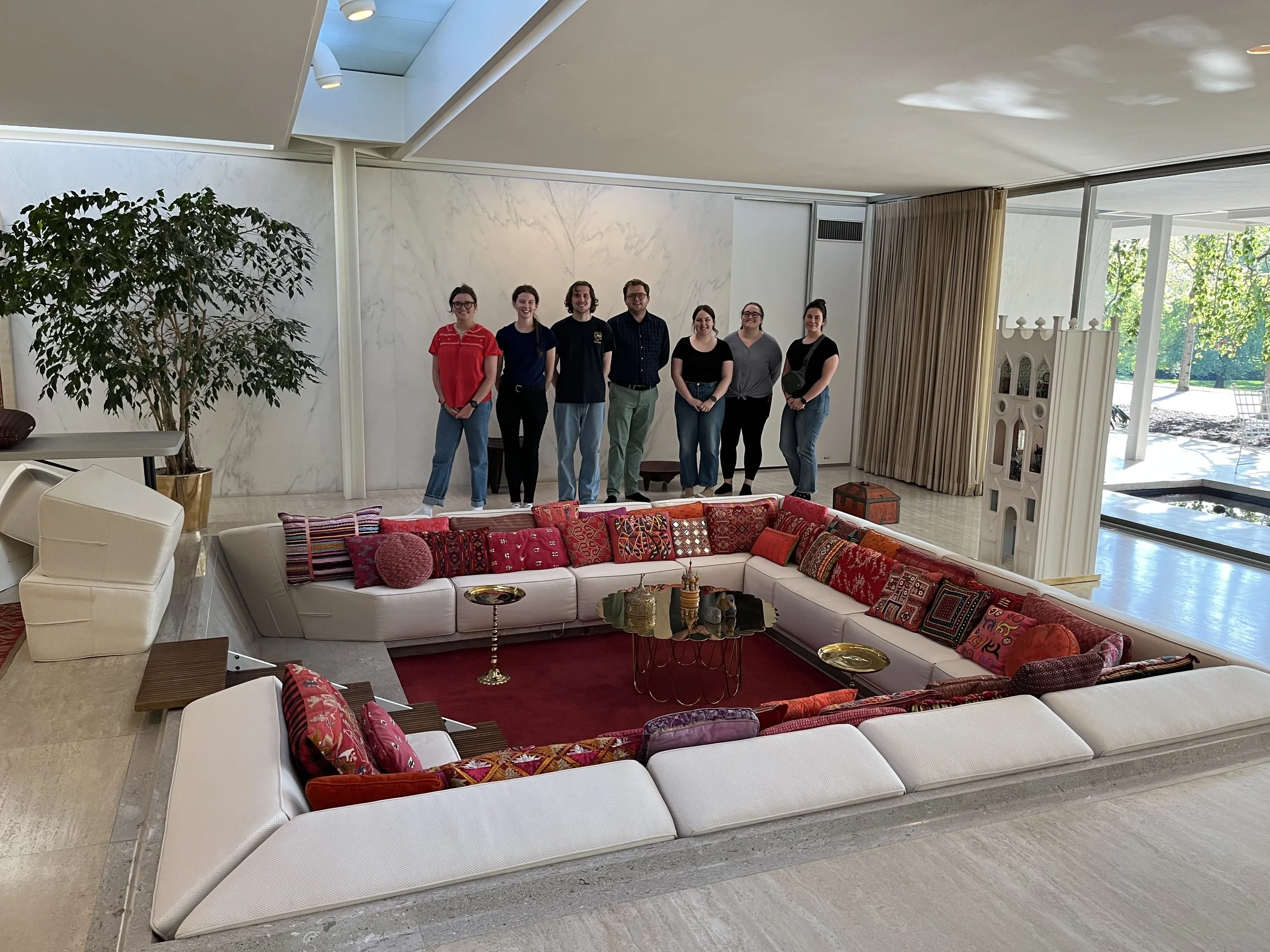
Learn about HPEF’s Partners in Documentation grant program and the recent Charles E. Peterson Prize-winning documentation of the Miller House with Jonathan Spodek at Ball State University.
The Pedagogy of Documentation: Integrating into Architecture
and Historic Preservation Curricula
Documentation has been part of architectural and preservation education for generations teaching students to collect, understand and communicate important characteristics of historic buildings in traditional 2-dimensional drawing form. Learning the method and techniques of architectural documentation still has a place in our curricula bridging theoretical knowledge and practical skills. Traditional hand measuring provided a methodological foundation that informs the use of ever evolving 3-D technologies. Documentation’s value can be seen through several lenses.
Through the lens of an ethnographer – Through immersive observation and measurement students are able to create “thick descriptions” of a place that goes beyond surface level observations in an effort to explain the layers of historic context. Students gain insights into the social and cultural frameworks that shaped the built environment.
Through the lens of an architect - Documentation requires students to make valuative judgements on what and how to document in order to convey understanding and context of an historic site. It teaches students to appreciate cultural heritage, understand traditional construction methods, and develop technical proficiency in analysis, measurement, and representation.
Through the lens of a conservator - Documentation provides detailed, accurate records necessary for the restoration and maintenance of historic structures. Documentation is the foundation of any future stewardship and intervention.
Through the lens of an observer – Documentation teaches critical thinking skills having students analyze existing buildings to evaluate the extant fabric and understand the relationship of the built environment to broader societal trends.
Jonathan Spodek, FAIA, FAPT is an Architect and Professor of Architecture at Ball State University whose research and professional practice are deeply rooted in historic preservation and sustainable building practices. Mr. Spodek’s first professional position was as an architect with the Historic American Buildings Survey where he served on several documentation teams including two important National Historic Landmarks: The Virginia Governor’s Mansion and Thomas Jefferson’s Home, Monticello. Following his work with HABS, Mr. Spodek was a preservation architect for several regional architecture and engineering firms based in Virginia. Mr. Spodek joined the faculty at Ball State University in 1998 where he teaches design studios and courses in building technology that include building documentation, historic building construction materials and techniques, and evaluation/diagnostic methods. His work involves the detailed documentation and review of both national and international historic sites exploring innovative approaches to preserving architectural history while planning for smart, sustainable futures.
______