In Tribute
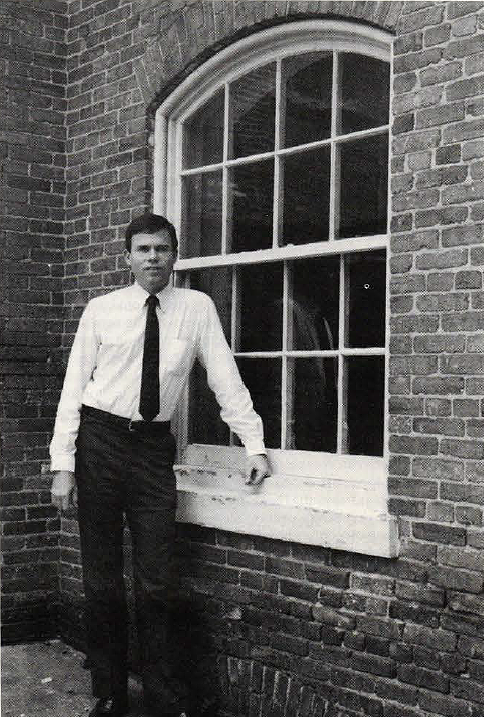
Charles Elbert Fisher III
1947-2025
Image Credit: Clem Labine, “The Prophet of Historic Windows,” Tradition Building (September/October 1989): 3.
For three decades, Chuck Fisher was a dear friend and great supporter of the Historic Preservation Education Foundation (HPEF), seeing in the organization the opportunity to expand the reach of National Park Service (NPS) knowledge and standards to practitioners far beyond those primarily working on NPS’s own historic sites and internal programs.
While HPEF had been founded in 1986, what led to Chuck’s early support of HPEF began more than a decade earlier. Chuck had joined NPS in 1975, shortly before the passage of the first federal tax incentives program for income producing historic properties in 1976, and within a decade of the founding of the Association of Preservation Technology International (APT), a joint venture between American and Canadian preservationists, and passage of the 1966 National Historic Preservation Act (NHPA) and its creation of the National Register of Historic Places. Chuck and his NPS peers acted on the need to expand NPS internal training programs and to produce materials that would expand the body of information available to those practicing or interested in historic preservation.
The NHPA and the tax credit program had created the need to build and strengthen relationships with the state historic preservation offices and, like APT, to promote the best technology for conserving historic structures and their settings. Chuck’s entire career focused on building these and other relationships and envisioning new approaches to training and education.
These new programs demanded the innovative development of educational materials and initiatives to promote the consistent application of preservation standards nationwide. Chuck contributed significantly to the development of NPS educational programs. His passion and commitment had earned him the trust of his coworkers and colleagues, both within and outside of the NPS. His research and authorship of technical materials, as well as his belief in the value of hands-on learning, led him to recognize the value of in-person events—symposia, conferences, trade shows, and exhibits of historic materials—that could build a national community of those involved in the technical aspects of preservation. Those benefitting from the convening of audiences practicing in the field of historic preservation included architects, engineers, landscape architects, conservators, historians, contractors, manufacturers, and students. Ultimately, the greatest benefits were bestowed on the very buildings undergoing rehabilitation and restoration.
Starting in the 1970s, working with preservation pioneers Lee Nelson, Ward Jandl, and others, Chuck was instrumental in collecting, organizing, and sharing with the public, the technical knowledge and expertise the U.S. government and private sector had developed as “professional methods and techniques for preserving, improving, restoring and maintaining historic properties.”
By the early 1980s, Chuck was the most prolific author of the Preservation Tech Notes series issued by the NPS Preservation Assistance Division, later renamed Technical Preservation Services. Over time, this role expanded as he became the NPS Technical Coordinator for the entire Tech Notes series and ultimately the Technical Publications Program Manager for all publications, including the Preservation Briefs series. One of his last major contributions before his 2017 retirement was the publication of Preservation Brief 50: Lightning Protection for Historic Structures. By then, driven by his own passion for history and building technology, Chuck had authored dozens of articles and worked with HPEF, APT, and other national and international organizations on a myriad of efforts to promote knowledge and improve the caliber of preservation projects.
Chuck perceived that the needs of the growing preservation field exceeded those that could be met by the NPS and other government entities alone. It is this understanding that, in 1986, helped support the creation of HPEF as a private, nonprofit organization that could partner with other organizations representing different facets of the preservation field. HPEF has since created or supported dozens of interdisciplinary opportunities that have included historians, conservators, landscape architects, interior designers, and manufacturers, as well as architects and engineers involved in preservation.
The first major national effort of HPEF collaborating with the NPS was the Windows Conference for Historic Buildings, held in Boston in 1986. The conference included a trade show and the Windows through Time exhibit of historic windows. The success of this first national conference, attended by more than 600 persons, led to a second window conference in Washington, DC, as well as two publications, multiple workshops dedicated to window repair, and the exhibit’s travel to the New York State Museum (Albany), Federal Hall (NYC), the National Building Museum (Washington, DC), Independence Hall (Philadelphia) and ultimately, to the National Building Arts Center in Sauget, Illinois, which received twenty-six of the windows and exhibit materials as part of its permanent collection in 2024.
For three decades, with Chuck’s guidance, HPEF partnered with the NPS on topics as diverse as preserving the recent past, stone masonry, roofing, building codes, historic interiors, and recreational structures. For these efforts and others undertaken, HPEF’s mission, to enhance “. . . public awareness and understanding of historic buildings and sites and encourages their appropriate preservation,” mirrors the efforts Chuck undertook in his forty years of service to the NPS. Chuck worked with HPEF to forge lasting relationships with manufacturers, institutions, and many other preservation organizations, from Columbia University to the Association for Preservation Technology. In recognition of his contributions to the field of preservation technology APT bestowed its highest honor, the Harley J. McKee award, on Chuck in 2001.
From his earliest days of collecting of Civil-war artifacts, as well as historic tools from which artifacts could be recreated for interpretative use at historic sites, Chuck’s passions for education and historic preservation lasted throughout his lifetime. He recognized that relationships with individuals and organizations were essential to expanding appreciation of these interests and served as a mentor and friend to many of those involved in HPEF over its first decades. Chuck boldly envisioned the impact HPEF programs could make on the field of historic preservation. As a friend and colleague, he was a generous mentor whose creative and strategic approaches to situations led him to see opportunities, and whose unwavering support helped launch the careers of others working in the field. He is one of the heroes of HPEF and the historic preservation movement and will be missed.
This remembrance was prepared by HPEF’s Former Board President Marilyn Kaplan, with review from additional Board members who knew and worked alongside Chuck.
The Chuck Fisher
Scholarship
Supporting professional development for emerging preservation professionals with an interest in historic trades.
To commemorate Chuck’s lasting legacy to our organization, HPEF will be creating a scholarship in his name to allow emerging professionals with an interest in historic trades to take part in professional development opportunities. If you would like to contribute to this effort, please follow the link below.